Appendix 7II, Description of the four scenarios

Description of the four scenarios
The assignment refers to four scenarios for future spatial developments, taken from the ‘Welfare, prosperity and quality of the living environment’ (WLO) scenario study (CPB et al., 2006). They provide a coherent framework for studying the distinguished developments and are ordered following two opposing trends:
- global (1) vs. regional (2); and
- market economy (A) vs. cooperation (B).
The four resulting scenarios are depicted below:
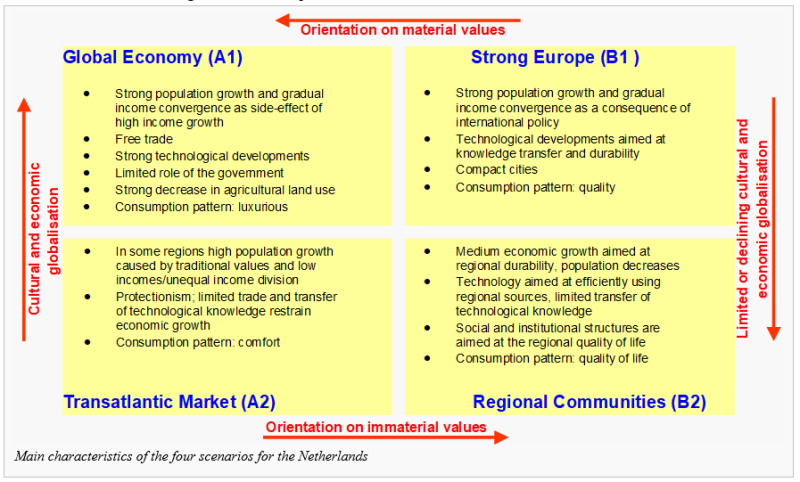
Global Economy combines globalisation with individualism, whereas Regional Communities connect regionalism with cooperation. In the A-type scenarios, people tend to focus more on material values, whereas, in the B-type scenarios, they focus on immaterial values. Likewise, in a 1-type world cultural and economic globalisation is an important trend whereas in a 2-type world, the opposite is the case. Each combination of trends (i.e. scenario) has specific characteristics, which are summarised below.
A1: The ‘Global Economy’ scenario assumes continuing globalisation and liberalisation, resulting in high economic growth and a fast introduction of new technologies. In this capitalized, market-oriented and individualistic world civilians are strongly focussed on the material aspects of life. The welfare state crumbles away.
A2: In the ‘Transatlantic Market’ scenario the traditional bonds between Western Europe and the United States are reinforced and a strong cultural and trade block emerges. The differences between the Western world and other (less wealthy) regions increase. Traditions are important in this world, which shows itself in a society oriented towards self-sufficiency, an industry aimed at ‘improving the existing’ instead of radical changes and civilians aimed at family values, status and comfort.
B1: In the ‘Strong Europe’ scenario globalisation continues, not only aimed at removing trade barriers but also at the exchange of knowledge and technologies between industrialised and developing countries. There is a general concern for the division of wealth and raw materials between people and for the management of nature and the environment. Solidarity shows itself in the form of a strong welfare state.
B2: The ‘Regional Communities’ scenario assumes an emphasis on the own identity and self-sufficiency within a region. Global developments are not a general concern and receive less attention. People are less materialistic and more focussed on the quality of their living environment. Solidarity is important and the national government plays an important role in the division of wealth and the protection of collective interests.
The scenarios are included in the land-use model in two ways:
- They set land-use claims per province: the additional area of every land-use type in 2030, 2040 and 2050; and
- They influence the relative importance of the factors that describe suitability.
The storylines come from the WLO study of 2006; the claims are derived from its successor, WLO 2025 (PBL, 2025). That study has two growth scenarios (Hoog and Laag) and, for the spatial pattern, two uncertainty explorations: Verdichting (densification) and Uitleg (urban expansion). The claims count from 2022, the year of the land-use map.
- Growth: A1 and B1, the global scenarios with the highest population growth in the 2006 study, follow Hoog; A2 and B2 follow Laag.
- Spatial pattern: the A scenarios (market, less restrictive policies) follow Uitleg, the B scenarios (cooperation, concentration near existing urban areas) follow Verdichting.
- Residential and industrial: the growth of the built-up area per COROP region in WLO 2025, adjusted and split with the factors of the exploration.
- Recreation: holiday parks as a share of the growth of the built-up area, plus day recreation that grows with the population.
- Nature: A1 and A2 the minimum of the Nature Network Netherlands (NNN), B1 its maximum, B2 the new nature of the Nature Outlook used in WLO 2025, realised before 2030.
- Building lot: stays at its current area.
- Agriculture: takes the rest, per province, assuming it is the weakest function (least spending power) in the competition for space.
The table below gives the expected land use in 2050. The sheet Explanation of the claims file describes the derivation in more detail. A more extensive description of the basic assumptions and spatial implications of the storylines is listed in the large table further below.
| Land-use type | A1 (GE) | A2 (TM) | B1 (SE) | B2 (RC) | Current land use (2022) |
|---|---|---|---|---|---|
| Residential | 364,393 | 310,262 | 334,781 | 307,159 | 297,644 |
| Industrial | 123,569 | 120,304 | 116,287 | 114,099 | 101,481 |
| Recreation | 150,972 | 136,010 | 154,856 | 139,319 | 125,994 |
| Nature | 583,587 | 583,587 | 619,587 | 643,467 | 548,587 |
| Building lot | 19,900 | 19,900 | 19,900 | 19,900 | 19,900 |
| Agriculture | 2,009,824 | 2,082,183 | 2,006,834 | 2,028,301 | 2,158,638 |
| Infrastructure | 108,537 | 108,537 | 108,537 | 108,537 | 108,537 |
| Water | 791,764 | 791,764 | 791,764 | 791,764 | 791,764 |
| Total | 4,152,546 | 4,152,546 | 4,152,546 | 4,152,546 | 4,152,546 |
Expected land use (hectares) in 2050 following the four scenarios, compared to the current situation (2022). Claims derived from WLO 2025 (PBL, 2025, cahier Regionale ontwikkelingen en ruimtegebruik) by Object Vision; current land use from CBS (Bestand Bodemgebruik NBBG2022).
Basic assumptions and related spatial implications for the scenarios
Go to previous page: Appendix 7I, Land Use Scanner Background