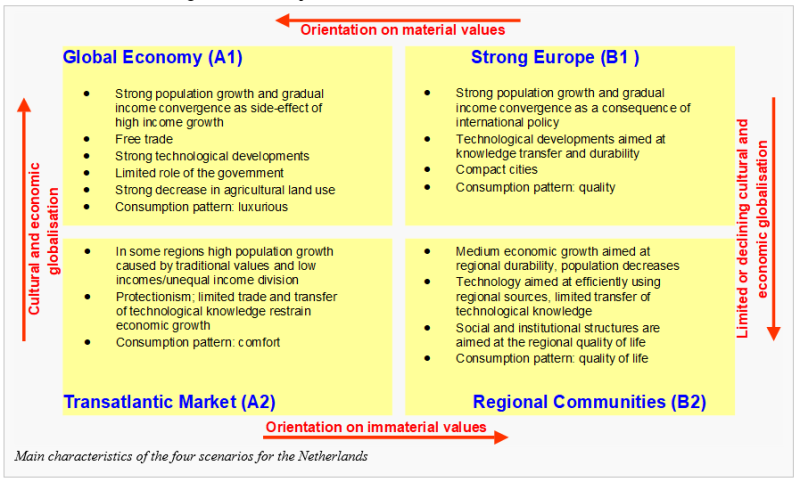
The assignment refers to four scenarios for future spatial developments, taken from the ‘Welfare, prosperity and quality of the living environment’ (WLO) scenario study (CPB et al., 2006). They provide a coherent framework for studying the distinguished developments and are ordered following two opposing trends:
global (1) vs. regional (2); and
market economy (A) vs. cooperation (B).
The four resulting scenarios are depicted below:
Global Economy combines globalisation with individualism, whereas Regional Communities connect regionalism with cooperation. In the A-type scenarios, people tend to focus more on material values, whereas, in the B-type scenarios, they focus on immaterial values. Likewise, in a 1-type world cultural and economic globalisation is an important trend whereas in a 2-type world, the opposite is the case. Each combination of trends (i.e. scenario) has specific characteristics, which are summarised below.
A1: The ‘Global Economy’ scenario assumes continuing globalisation and liberalisation, resulting in high economic growth and a fast introduction of new technologies. In this capitalized, market-oriented and individualistic world civilians are strongly focussed on the material aspects of life. The welfare state crumbles away.
A2: In the ‘Transatlantic Market’ scenario the traditional bonds between Western Europe and the United States are reinforced and a strong cultural and trade block emerges. The differences between the Western world and other (less wealthy) regions increase. Traditions are important in this world, which shows itself in a society oriented towards self-sufficiency, an industry aimed at ‘improving the existing’ instead of radical changes and civilians aimed at family values, status and comfort.
B1: In the ‘Strong Europe’ scenario globalisation continues, not only aimed at removing trade barriers but also at the exchange of knowledge and technologies between industrialised and developing countries. There is a general concern for the division of wealth and raw materials between people and for the management of nature and the environment. Solidarity shows itself in the form of a strong welfare state.
B2: The ‘Regional Communities’ scenario assumes an emphasis on the own identity and self-sufficiency within a region. Global developments are not a general concern and receive less attention. People are less materialistic and more focussed on the quality of their living environment. Solidarity is important and the national government plays an important role in the division of wealth and the protection of collective interests.
The scenarios are included in the land-use model in two ways:
They set regional or national land-use claims, by predicting a future surface area for every land-use type; and
They influence the relative importance of the factors that describe suitability.
The table below contains the expected total surface area of each land-use type for the four scenarios. These are included in the model version that will be used for the assignment. The figures in this table are derived from different sector-specific models and are based on the trends and assumptions for each scenario. As can be seen from the claim table, three of the four scenarios have a total land-use demand that is greater than the current land use, indicating over-demand. We solve this problem in our model by taking additional land from agriculture assuming that this function will be the weakest (least spending power) in the competition for space.
A more extensive description of the related basic assumptions and spatial implications is listed in the large table further below.
Land-use type
A1 (GE)
A2 (TM)
B1 (SE)
B2 (RC)
Current land use (2010)
Residential
362963
318748
321098
278558
273110
Industrial
116087
96556
93161
73778
87470
Recreation
142504
115438
124934
106245
98829
Agriculture
2026500
2134310
2081980
2136390
2264360
Nature
599113
582113
624112
607113
486551
Building lot
39
39
1919
40977
36882
Infrastructure
121461
121461
121461
121461
121461
Water
785629
785629
785629
785629
785629
Exterior
-
-
-
-
-
Total demand
4154296
4154294
4154294
4150151
4154292
Expected land use (hectares) in 2040 following the four scenarios, compared to the current situation (2010), source: WLO (2006), adapted by SPINlab - Vrije Universiteit Amsterdam
Basic assumptions and related spatial implications for the scenarios
Global Economy
A1_GE
Transatlantic Market
A2_TM
Strong Europe
B1_SE
Regional Communities
B2_RC
Socio-economic conditions
Economic growth
Highest
High
Medium
Low
Population (2040)
20 million
17 million
19 million
16 million
Societal focus
Individual freedom
Individual freedom
Global cooperation
Regional cooperation
Recreation
Not much spare time, emphasis on active leisure, accessibility and proximity to residential areas are important
More spare time than in A1 and B1, emphasis is on rest & relaxation
Valuable (more than in A1), people also like to go into nature areas, but some nature areas are restricted. Accessibility by road and by rail are important
Valuable, people also like to go into nature areas
General and sector-specific spatial policy
Economic orientation
Free market prevails, globalisation
Free market prevails, protectionism
Government intervenes, strong international institutions
Government intervenes, strong local and regional institutions
Spatial policy
Less restrictive policies
Less restrictive policies
Restrictive policies for rural areas
Restrictive policies for rural areas
Agricultural policy
Free world markets for agricultural products
Internal EU support under conditions, no export subsidies
Regulated world markets for agricultural products
Internal EU support under conditions, no export subsidies
Nature protection & development
Only the most valuable natural areas are protected.
International treaties are followed. Acquisition through private persons and organisations
Symbolic role of the government, general trend: nature serves humanity.
International treaties are followed. Nature appears where agricultural land disappears. Nature is pushed aside by urbanisation processes
Global environmental policy, strong international institutions. International treaties are followed and acquired by national government following Ecological main structure (EHS)
Larger areas protected, Ecological main structure realised.
International treaties are followed and acquired by national government following Ecological main structure (EHS)
Agriculture and nature conservation
Strong decline of agricultural land use. No chances for agriculture combined with natural values
Agricultural land use remains the same or decreases slightly. No chances for agriculture combined with natural values
Agricultural land use remains the same or decreases slightly. Room for agricultural nature management
Decline of agricultural land use follows the historic trend. Diversified rural development, much room for agricultural nature management
Water management
Building near rivers is allowed
Building near rivers is allowed reluctantly
Restrictions on urbanisation in designated areas
Restrictions on urbanisation in designated areas
Expected spatial developments
Urbanisation
Urban sprawl in rural areas. Accessibility by road to and from urban areas is important. Attractive surroundings are important for residences.
Urban sprawl in rural areas. Accessibility by road to and from urban areas is very important. Proximity to an airport is important. Attractiveness of the surroundings is not important
Concentration near existing urban areas, no new residential areas near airports
Concentration near existing urban areas, no new residential areas near airports and in low-lying rural areas
Commercial functions
Abundant growth, preference for highway locations
High growth, strong preference for highway locations
Medium growth, public transport accessibility promoted, also preference for highway locations
Limited growth, public transport accessibility strongly promoted